Product
Product
Report: Early 2025 AI Ecosystem Trends
Report: Early 2025 AI Ecosystem Trends
Report: Early 2025 AI Ecosystem Trends
Mar 10, 2025
Mar 10, 2025
Poe’s goal is to be the best place to explore, compare, and harness the outputs of AI models. In the two years since launching, we have brought 100+ text, image, video, and audio models from leading AI companies to millions of users on our platform, which has provided a unique view into demand and usage trends.
As AI models continue to progress, we believe they will become central to how people acquire knowledge, tackle complex tasks, and manage everyday work. Today, we’re excited to share insights and aggregated data from Poe’s usage over the past year, offering researchers and the public a glimpse into this rapidly expanding AI ecosystem. [1] [2]
In text, message share across OpenAI & Anthropic at ~85%; Google, DeepSeek, xAI & others gaining traction
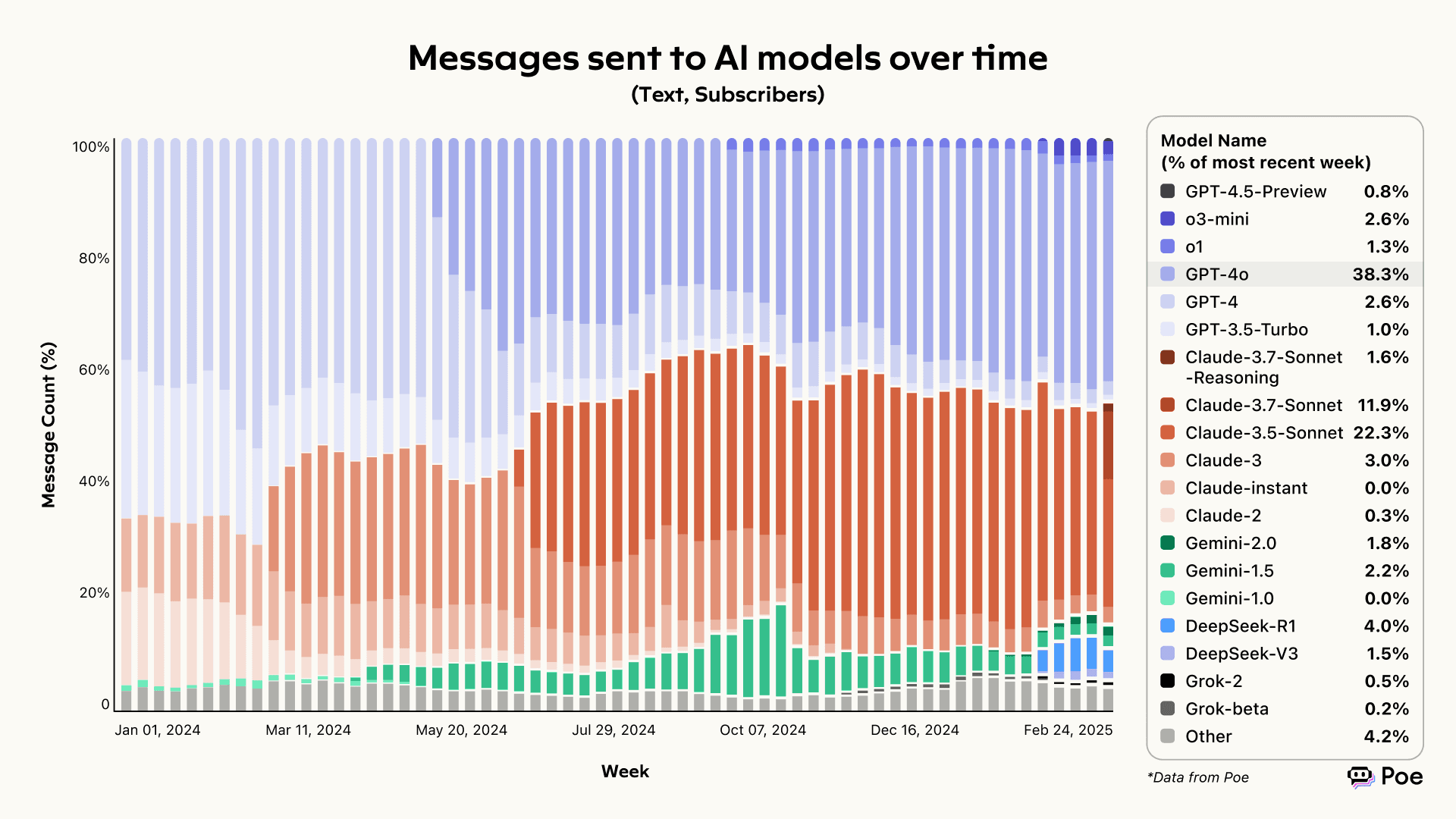
Anthropic usage among Poe subscribers grew rapidly throughout 2024. Since Claude 3.5 Sonnet’s launch in June 2024, text usage across OpenAI and Anthropic models has been nearly equal, showcasing growing competition in the highly expressive text modality.
As frontier labs release more capable models, usage of the new flagship model in a provider’s offering quickly cannibalizes the older versions (e.g. GPT-4 → GPT-4o, Claude-3 → Claude 3.5).
DeepSeek-R1 and -V3 went from no usage in December 2024 to gain 7% of messages at their peak, a significantly higher level than any previous open-source model family, such as Llama & Mistral. [3]
Google’s Gemini family saw growing message share through October 2024, but has been declining since. The long-tail of “other” official models has been growing over the same period, highlighting increased model diversity that subscribers regularly enjoy.
In image generation, the FLUX family and Imagen3 are on the rise, amid a crowded field
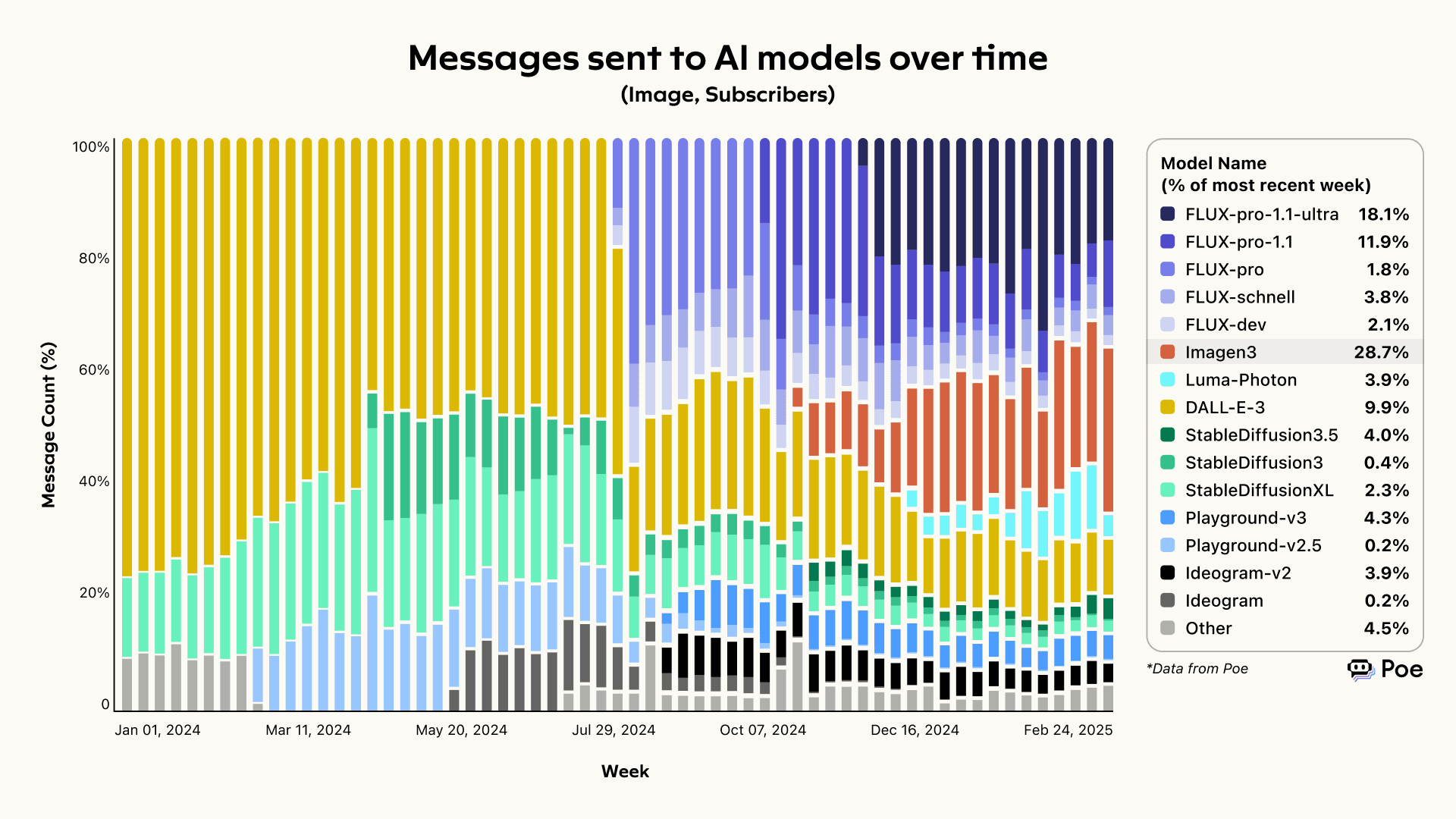
First-mover image gen models like DALL-E-3 and various StableDiffusion versions were pioneers in the space, but have seen their relative usage share drop nearly 80% as the number of official image gen models has grown from 3 to ~25.
BlackForestLabs’s FLUX family of image generation models burst onto the scene in mid 2024 and has maintained its dominant position as the clear frontrunner since, capturing close to 40% of messages.
Google's Imagen3 family has been on a steady growth since its late 2024 launch, carving out almost 30% usage share, across its premiere Imagen3 model and more optimized Imagen3-Fast.
Dedicated image gen providers like Playground and Ideogram have remained relevant, pushing frequent model updates & refreshes, but still collectively only account for ~10% share.
In Video, Google’s Veo-2 emerges to challenge incumbent Runway
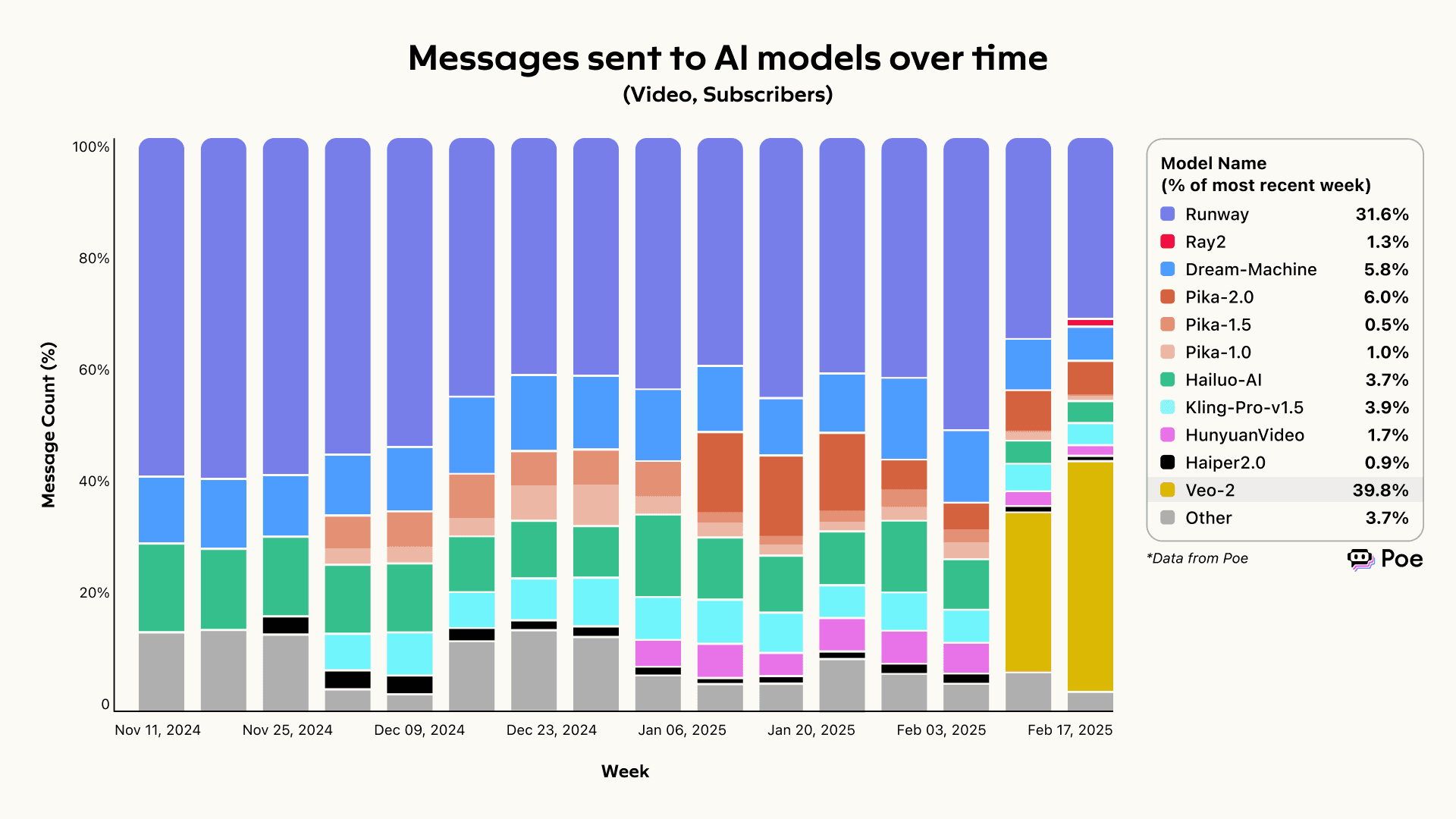
The video generation category, while only existing starting in late 2024, has rapidly expanded to more than eight providers now offering diverse options to subscribers depending on their exact needs.
Despite some decline in usage share over time and only offering a single model in their API since its launch in September 2024, Runway has maintained a strong position with 30-50% of video gen messages.
Google’s Veo-2, since its recent launch on Poe, rapidly captured nearly 40% of total video gen messages in just a few weeks
Chinese models like Kling-Pro-v1.5, Hailuo-AI, HunyuanVideo and Wan-2.1 continue to push the frontier on capabilities, inference time, and cost, collectively accounting for ~15% of video gen messages. [3]
Conclusion
We hope these findings offer a glimpse into the shifting dynamics of the AI model landscape, and we look forward to sharing additional updates if there’s enough community interest. In the future, we hope to dive deeper into real-world usage patterns—exploring which generative AI models users prefer for specific tasks, at different price points, how these preferences align (or diverge) from publicly reported benchmarks, and whether certain model pairings or user loyalty factors emerge as meaningful trends. If you’d like to see these insights firsthand and judge for yourself, you can sign up to interact with than 100 official bots on Poe today at https://poe.com/ with subscription plans starting as low as $5/month.
Poe’s goal is to be the best place to explore, compare, and harness the outputs of AI models. In the two years since launching, we have brought 100+ text, image, video, and audio models from leading AI companies to millions of users on our platform, which has provided a unique view into demand and usage trends.
As AI models continue to progress, we believe they will become central to how people acquire knowledge, tackle complex tasks, and manage everyday work. Today, we’re excited to share insights and aggregated data from Poe’s usage over the past year, offering researchers and the public a glimpse into this rapidly expanding AI ecosystem. [1] [2]
In text, message share across OpenAI & Anthropic at ~85%; Google, DeepSeek, xAI & others gaining traction
Anthropic usage among Poe subscribers grew rapidly throughout 2024. Since Claude 3.5 Sonnet’s launch in June 2024, text usage across OpenAI and Anthropic models has been nearly equal, showcasing growing competition in the highly expressive text modality.
As frontier labs release more capable models, usage of the new flagship model in a provider’s offering quickly cannibalizes the older versions (e.g. GPT-4 → GPT-4o, Claude-3 → Claude 3.5).
DeepSeek-R1 and -V3 went from no usage in December 2024 to gain 7% of messages at their peak, a significantly higher level than any previous open-source model family, such as Llama & Mistral. [3]
Google’s Gemini family saw growing message share through October 2024, but has been declining since. The long-tail of “other” official models has been growing over the same period, highlighting increased model diversity that subscribers regularly enjoy.
In image generation, the FLUX family and Imagen3 are on the rise, amid a crowded field
First-mover image gen models like DALL-E-3 and various StableDiffusion versions were pioneers in the space, but have seen their relative usage share drop nearly 80% as the number of official image gen models has grown from 3 to ~25.
BlackForestLabs’s FLUX family of image generation models burst onto the scene in mid 2024 and has maintained its dominant position as the clear frontrunner since, capturing close to 40% of messages.
Google's Imagen3 family has been on a steady growth since its late 2024 launch, carving out almost 30% usage share, across its premiere Imagen3 model and more optimized Imagen3-Fast.
Dedicated image gen providers like Playground and Ideogram have remained relevant, pushing frequent model updates & refreshes, but still collectively only account for ~10% share.
In Video, Google’s Veo-2 emerges to challenge incumbent Runway
The video generation category, while only existing starting in late 2024, has rapidly expanded to more than eight providers now offering diverse options to subscribers depending on their exact needs.
Despite some decline in usage share over time and only offering a single model in their API since its launch in September 2024, Runway has maintained a strong position with 30-50% of video gen messages.
Google’s Veo-2, since its recent launch on Poe, rapidly captured nearly 40% of total video gen messages in just a few weeks
Chinese models like Kling-Pro-v1.5, Hailuo-AI, HunyuanVideo and Wan-2.1 continue to push the frontier on capabilities, inference time, and cost, collectively accounting for ~15% of video gen messages. [3]
Conclusion
We hope these findings offer a glimpse into the shifting dynamics of the AI model landscape, and we look forward to sharing additional updates if there’s enough community interest. In the future, we hope to dive deeper into real-world usage patterns—exploring which generative AI models users prefer for specific tasks, at different price points, how these preferences align (or diverge) from publicly reported benchmarks, and whether certain model pairings or user loyalty factors emerge as meaningful trends. If you’d like to see these insights firsthand and judge for yourself, you can sign up to interact with than 100 official bots on Poe today at https://poe.com/ with subscription plans starting as low as $5/month.
Notes
[1] All user information is handled as outlined by Poe’s privacy policy, which among other things explicitly forbids model providers from using any inputs submitted through Poe for training purposes. We applaud the efforts of organizations like Anthropic for their work on Clio, to provide insights on user tasks in a privacy-preserving manner.
[2] All usage and spending data shown are based on Poe subscribers. Each bar in the plots represents one calendar week of data, from Monday to Sunday. Since GPT-4.5-Preview was released on February 27, 2025 (Thursday), it has only half a week of data as of this post’s completion. All charts are normalized to percentage shares to control for subscriber growth over time. Over the past 12+ months, Poe’s mechanism for covering costs associated with LLM inference has changed. For the text modality analysis, messages to Poe’s Assistant bot is excluded.
[3] All official providers of DeepSeek, Hailuo-AI, Kling, Hunyuan & Wan 2.1 models on Poe are based in the US, bound by Poe’s privacy policy, and do not send data to mainland China.
Notes
[1] All user information is handled as outlined by Poe’s privacy policy, which among other things explicitly forbids model providers from using any inputs submitted through Poe for training purposes. We applaud the efforts of organizations like Anthropic for their work on Clio, to provide insights on user tasks in a privacy-preserving manner.
[2] All usage and spending data shown are based on Poe subscribers. Each bar in the plots represents one calendar week of data, from Monday to Sunday. Since GPT-4.5-Preview was released on February 27, 2025 (Thursday), it has only half a week of data as of this post’s completion. All charts are normalized to percentage shares to control for subscriber growth over time. Over the past 12+ months, Poe’s mechanism for covering costs associated with LLM inference has changed. For the text modality analysis, messages to Poe’s Assistant bot is excluded.
[3] All official providers of DeepSeek, Hailuo-AI, Kling, Hunyuan & Wan 2.1 models on Poe are based in the US, bound by Poe’s privacy policy, and do not send data to mainland China.
Sign up for Poe today
Instant access to the best AI products all in one place
Sign up for Poe today
Instant access to the best AI products all in one place
Sign up for Poe today
Instant access to the best AI products all in one place